Consider the linear transformation \(T\colon\IR^4\to\IR^3\) that is represented by the standard matrix \(A=\left[\begin{array}{cccc} 3 & 4 & 7 & 1\\ -1 & 1 & 0 & 2 \\ 2 & 1 & 3 & -1 \end{array}\right].\) Which of the following processes helps us compute a basis for \(\Im T\) and which helps us compute a basis for \(\ker T\text{?}\)
Let \(T: V \rightarrow W\) be a linear transformation. \(T\) is called injective or one-to-one if \(T\) does not map two distinct vectors to the same place. More precisely, \(T\) is injective if \(T(\vec{v}) \neq T(\vec{w})\) whenever \(\vec{v} \neq \vec{w}\text{.}\)
Two examples are shown. The one on the left illustrates a transformation from \(\IR^2\) to \(\IR^3\) with the \(xy\) coordinate axes (with two distinct vectors labeled \(\vec{v}\) and \(\vec{w}\) shown) connected by a curved dashed arrow to the right to an image of the \(xyz\) coordinate axes. The images of the individual vectors are shown and are distinct, labeled \(T(\vec{v})\) and \(T(\vec{w})\text{.}\) This example is labeled below as "injective".
The example on the right illustrates a transformation from \(\IR^3\)to \(\IR^3\) with the \(xyz\) coordinate axes (with two distinct vectors labeled \(\vec{v}\) and \(\vec{w}\) shown) connected by a curved dashed arrow to the right to an image of the \(xy\) coordinate axes. The images of the individual vectors are shown and are the same, labeled \(T(\vec{v})=T(\vec{w})\text{.}\) This example is labeled below as "not injective".
No, because \(T\left(\left[\begin{array}{c}0\\0\\1\end{array}\right]\right)
\not=
T\left(\left[\begin{array}{c}0\\0\\2\end{array}\right]\right)
\text{.}\)
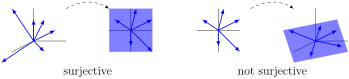
Let \(T: V \rightarrow W\) be a linear transformation. \(T\) is called surjective or onto if every element of \(W\) is mapped to by an element of \(V\text{.}\) More precisely, for every \(\vec{w} \in W\text{,}\) there is some \(\vec{v} \in V\) with \(T(\vec{v})=\vec{w}\text{.}\)
Two examples are shown. The one on the left illustrates a transformation from \(\IR^3\) to \(\IR^2\) with the \(xyz\) coordinate axes (with several arbitrary vectors illustrated) connected by a curved dashed arrow to the right to an image of the \(xy\)-plane. The images of the individual arbitrary vectors are shown, and the entire \(xy\) plane is shaded, representing that they span the entire space \(\IR^2\text{.}\) This example is labeled below as "surjective".
The example on the right illustrates a transformation from \(\IR^2\)to \(\IR^3\) with the \(xy\) coordinate axes (with several arbitrary vectors illustrated) connected by a curved dashed arrow to the right to an image of the \(xyz\) coordinate axes. The images of the individual arbitrary vectors are shown, all lying in a two dimensional plane which is shaded. This example is labeled below as "not surjective".
Yes, because for every \(\vec w=\left[\begin{array}{c}x\\y\\z\end{array}\right]\in\IR^3\text{,}\) there exists \(\vec v=\left[\begin{array}{c}x\\y\end{array}\right]\in\IR^2\) such that \(T(\vec v)=\vec w\text{.}\)
No, because \(T\left(\left[\begin{array}{c}x\\y\end{array}\right]\right)\) can never equal \(\left[\begin{array}{c} 1 \\ 1 \\ 1 \end{array}\right]
\text{.}\)
No, because \(T\left(\left[\begin{array}{c}x\\y\end{array}\right]\right)\) can never equal \(\left[\begin{array}{c} 0 \\ 0 \\ 0 \end{array}\right]
\text{.}\)
Yes, because for every \(\vec w=\left[\begin{array}{c}x\\y\end{array}\right]\in\IR^2\text{,}\) there exists \(\vec v=\left[\begin{array}{c}x\\y\\42\end{array}\right]\in\IR^3\) such that \(T(\vec v)=\vec w\text{.}\)
Yes, because for every \(\vec w=\left[\begin{array}{c}x\\y\end{array}\right]\in\IR^2\text{,}\) there exists \(\vec v=\left[\begin{array}{c}0\\0\\z\end{array}\right]\in\IR^3\) such that \(T(\vec v)=\vec w\text{.}\)
No, because \(T\left(\left[\begin{array}{c}x\\y\\z\end{array}\right]\right)\) can never equal \(\left[\begin{array}{c} 3\\-2 \end{array}\right]
\text{.}\)
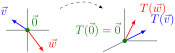
A linear transformation \(T\) is injective if and only if\(\ker T = \{\vec{0}\}\text{.}\) Put another way, an injective linear transformation may be recognized by its trivial kernel.
The \(xy\)-plane on the left, with the zero vector \(\vec{0}\) and two distinct, non-parallel arbitrary vectors labeled \(\vec{v}\) and \(\vec{w}\text{,}\) connected by a curved dashed arrow to the right to the \(xyz\) coordinate axes, representing \(\IR^3\text{.}\) Three vectors are shown in \(\IR^3\text{:}\) the zero vector, labeled \(T(\vec{0})=\vec{0}\text{;}\) and nonzero, non-parallel vectors \(T(\vec{v})\) and \(T(\vec{w})\text{.}\)
Figure32.A linear transformation with trivial kernel, which is therefore injective
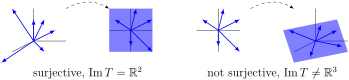
A linear transformation \(T:V \rightarrow W\) is surjective if and only if\(\Im T = W\text{.}\) Put another way, a surjective linear transformation may be recognized by its identical codomain and image.
Two examples are shown. The one on the left illustrates a transformation from \(\IR^3\) to \(\IR^2\) with the \(xyz\) coordinate axes (with several arbitrary vectors illustrated) connected by a curved dashed arrow to the right to an image of the \(xy\)-plane. The images of the individual arbitrary vectors are shown, and the entire \(xy\) plane is shaded, representing that they span the entire space \(\IR^2\text{.}\) This example is labeled below as "surjective, \(\Im T = \IR^2\)".
The example on the right illustrates a transformation from \(\IR^2\)to \(\IR^3\) with the \(xy\) coordinate axes (with several arbitrary vectors illustrated) connected by a curved dashed arrow to the right to an image of the \(xyz\) coordinate axes. The images of the individual arbitrary vectors are shown, all lying in a two dimensional plane which is shaded. This example is labeled below as "not surjective, \(\Im T \neq \IR^3\)".
Figure33.A linear transformation with identical codomain and image, which is therefore surjective; and a linear transformation with an image smaller than the codomain \(\IR^3\text{,}\) which is therefore not surjective.
Let \(T: \IR^n \rightarrow \IR^m\) be a linear map with standard matrix \(A\text{.}\) Determine whether each of the following statements means \(T\) is (A) injective, (B) surjective, or (C) bijective (both).
The kernel of \(T\) is trivial, i.e. \(\ker T=\{\vec 0\}\text{.}\)
Let \(T: \IR^n \rightarrow \IR^m\) be a linear map with standard matrix \(A\text{.}\) Determine whether each of the following statements means \(T\) is (A) injective, (B) surjective, or (C) bijective (both).
Let \(T: \IR^n \rightarrow \IR^m\) be a linear map with standard matrix \(A\text{.}\) Determine whether each of the following statements means \(T\) is (A) injective, (B) surjective, or (C) bijective (both).
Let \(T: \IR^n \rightarrow \IR^m\) be a linear map with standard matrix \(A\text{.}\) Determine whether each of the following statements means \(T\) is (A) injective, (B) surjective, or (C) bijective (both).
The system of linear equations given by the augmented matrix \(\left[\begin{array}{c|c}A & \vec{b} \end{array}\right]\) has a solution for all \(\vec{b} \in \IR^m\text{.}\)
The system of linear equations given by the augmented matrix \(\left[\begin{array}{c|c}A & \vec{b} \end{array}\right]\) has exactly one solution for all \(\vec{b} \in \IR^m\text{.}\)
What can you conclude about the linear map \(T:\IR^2\to\IR^3\) with standard matrix \(\left[\begin{array}{cc} a & b \\ c & d \\ e & f \end{array}\right]\text{?}\)
What can you conclude about the linear map \(T:\IR^3\to\IR^2\) with standard matrix \(\left[\begin{array}{ccc} a & b & c \\ d & e & f \end{array}\right]\text{?}\)
Basically, a linear transformation cannot reduce dimension without collapsing vectors into each other, and a linear transformation cannot increase dimension from its domain to its image.
Two examples are shown. The one on the left illustrates a transformation from \(\IR^3\) to \(\IR^2\) with the \(xyz\) coordinate axes (with two non-parallel vectors \(\vec{v}\) and \(\vec{w}\) shown) connected by a curved dashed arrow to the right to an image of the \(xy\)-plane. A single vector is shown in the \(xy\)-plane, labeled \(T(\vec{v})=T(\vec{w})\text{.}\) This example is labeled below as "not injective, \(3>2\)".
The example on the right illustrates a transformation from \(\IR^2\)to \(\IR^3\) with the \(xy\) coordinate axes (with several arbitrary vectors illustrated) connected by a curved dashed arrow to the right to an image of the \(xyz\) coordinate axes. The images of the individual arbitrary vectors are shown, all lying in a two dimensional plane which is shaded. This example is labeled below as "not surjective, \(2 <3\)".
Figure34.A linear transformation whose domain has a larger dimension than its codomain, and is therefore not injective; and a linear transformation whose domain has a smaller dimension than its codomain, and is therefore not surjective.
The system of linear equations given by the augmented matrix \(\left[\begin{array}{c|c} A & \vec{b} \end{array}\right]\) has exactly one solution for each \(\vec b \in \IR^n\text{.}\)
\begin{equation*}
T\left(\left[\begin{array}{c} x \\ y \\ z \end{array}\right] \right) =
\left[\begin{array}{c} 2x+y-z \\ 4x+y+z\end{array}\right].
\end{equation*}
Let \(T\colon\IR^n\to\IR^m\) be a linear transformation with standard matrix \(A\text{.}\) We reasoned during class that the following statements are logically equivalent:
While they are all logically equivalent, they are different statements that offer varied perspectives on our growing conceptual knowledge of linear algebra.
Let \(T\colon\IR^n\to\IR^m\) be a linear transformation with standard matrix \(A\text{.}\) We reasoned during class that the following statements are logically equivalent:
The columns of \(A\) span all of \(\IR^m\text{.}\)
While they are all logically equivalent, they are different statements that offer varied perspectives on our growing conceptual knowledge of linear algebra.
Suppose that \(f:V \rightarrow W\) is a linear transformation between two vector spaces \(V\) and \(W\text{.}\) State carefully what conditions \(f\) must satisfy. Let \(\vec{0_V}\) and \(\vec{0_W}\) be the zero vectors in \(V\) and \(W\) respectively.
Prove that \(f\) is one-to-one if and only if \(f(\vec{0_V}) = \vec{0_W}\text{,}\) and that \(\vec{0_V}\) is the unique element of \(V\) which is mapped to \(\vec{0_W}\text{.}\) Remember that this needs to be done in both directions. First, prove the if and only if statement, and then show the uniqueness.
Do not use subtraction in your proof. The only vector space operation we have is addition, and a structure-preserving function only preserves addition. If you are writing \(\vec{v} - \vec{v} = \vec{0}_V\text{,}\) what you really mean is that \(\vec{v} \oplus \vec{v}^{-1} = \vec{0}_V\text{,}\) where \(\vec{v}^{-1}\) is the additive inverse of \(\vec{v}\text{.}\)
For each basis vector in \(V\text{,}\) define a function that returns 1 if it’s given that basis vector, and returns 0 if it’s given any other basis vector. For example, if \(\vec{b_i}\) and \(\vec{b_j}\) are each members of the basis for \(V\text{,}\) and you’ll need a function \(f_i:V \rightarrow \{0,1\}\text{,}\) where \(f_i(b_i) = 1\) and \(f_i(b_j)= 0\) for all \(j \neq i\text{.}\)
Show that the functions you found in the last part are a basis for \(V^*\text{?}\) To do this, take an arbitrary function \(h \in V^*\) and some vector \(\vec{v} \in V\text{.}\) Write \(\vec{v}\) in terms of the basis you chose earlier. How can you write \(h(\vec{v})\text{,}\) with respect to that basis? Pay attention to the fact that all functions in \(V^*\) are linear.